Welcome to my Grange.
 |
|
|
|
It must be a little world because I can contact most of it from here.
The strange dial sticking out of the right side of my head is a barometer for measuring air pressure, not inside my head but atmospheric pressure. The other strange object sitting on top of the switch boxes will be immediately recognisable by a few strange people who have difficulty with one of their trouser legs.
I retired from my profession during 1995 and began building kites to further my hobby of Amateur
Radio, fortunately or unfortunately depending on your point of view the kite building began to take over
my life and I inadvertently found myself working full time again. I now only build kites when I feel like it, It's
only a hobby now and that's the way I intend it to stay. |
|
|
|
I lost the circuit diagram my TM-1000 some time ago and opened the case to try and figure out the circuitry and the diagram below is my best attempt. ... 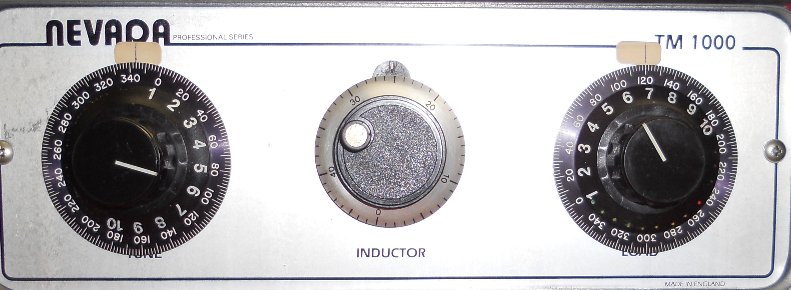 The front panel of the TM1000. To refine the tuning I added two large 360° calibrated escutcheon plates which helps when noting down the settings for a particular frequency. 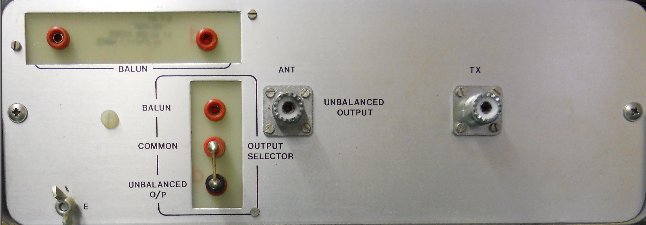 The rear panel of the TM1000 is relatively uncluttered. If you look carefully between the balun output connectors you will see faint writing. This is the name of the chap (A Radio Amateur ) who built this unit together with his call sign and home address. I looked him up on QRZ and he apparently still lives at that location. 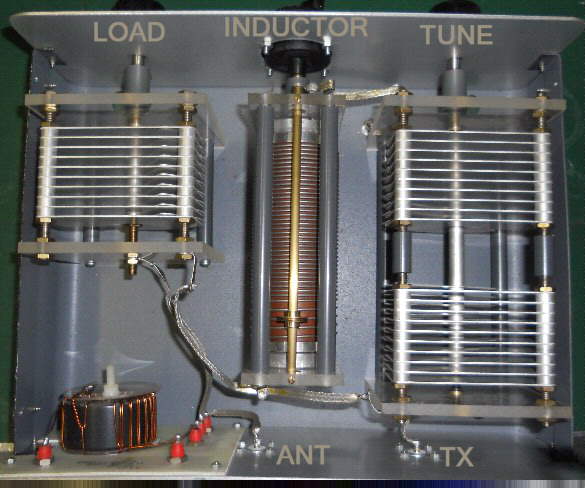 The inner workings of the TM100 .... what a testament to his craftsmanship. Don't worry about the two pigtails touching one another, there is at least two inches separating them. The balun winding appears to be an auto transformer type but I can't be sure without first disassembling it. If you can give enlightenment I will print it here. This page has provoked some questions which need answers which I am not qualified to give. However in the interests of the Amateur Radio fraternity I think one solution is to publish the questions here in the hope that soloutions may be found. Roland wrote: Hi Adrian I just picked up a TM1000 ATU minus the toroid. Looking at your web page is that a 9:1 balun in there. I want to put it back to it’s original condition and need any info I can get. Hi Roley, I think it's a 4:1 balun with roughly 24 turns on a large ferrite ring. (TOROID) A large ring can be made using two stuck together. It is preferable to use the biggest toroid that you can find as small ones tend to get hot. 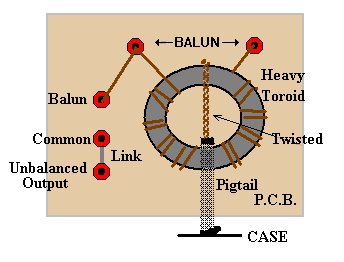
=========================================== Hi Adrian, I came across your web page regarding the above ATU, I acquired one recently, unfortunately, not in very good condition. It was damaged in transit, the bottom corner of the case is badly dented so I have striped the unit to repair the case and get it re-sprayed. I wonder if you could help with the following queries. 1) Could you supply a copy of the original manual, I will gladly reimburse any cost?. 2) Do you know the value of the small and large capacitor capacitance? 3) The turns counter dial on the roller- coaster is damaged beyond repair, do you know where I might obtain a replacement. Nevada were of no help they don’t know anything about this unit because of its’ age? 4) Have you had any problems with high resistance on the roller-coaster bearings, unless I am mistaken electrical contact is taken through the ball bearings of the end bearings. I once built an ATU using the same roller-coaster and I had to fabricate a different method of connection. The resistance through the bearings was several ohms, not good at high powers. Sorry to bother you, I got your email address from QRZ.com. Hope you can help. 73 Peter Hi Peter, I purchased the unit from Nevada over thirty years ago and the circuit diagram came with it, unfortunately over the years involving change of address it somehow got lost. When I say lost it is probably stored safely in one of my back issues of Practical Wireless ..... It consisted of a photocopied A4 folded. That's Q1 sorted. Re Q2 I believe they are 500 pF's Re Q3 http://www.minute-man.com/acatalog/Vernier_Dial_for_Potentiometers.html there is an image of the "Vernier Turns Counter" at that address. use ....Vernier turns counter on Gooooogle. Re 4 High resistance on bearings. ........ Depends on the wiring of your unit and its use. If the unit is used frequently resistance is only measurable using the four point method and should be less than .001 1/000th Ohm. or a small fraction of a dB. Do not remove the bearings add a rotating compression contact in addition. QRZ has a lot to answer for. Good luck with the refurbish. Kindest Regards Adrian Hi Adrian It’s me again! Just an update and some queries. First of all I’ve ended up getting the ATU free of charge!! The guy sent me my money back because of the damage in transit, although that was clearly not his fault. He was claiming on the insurance so he must have been pretty sure the claim would be upheld. I told him to hang on until he received a cheque from the insurance company but his cheque with a full refund including the postage arrived next day. I must say it restores your faith in human nature. I managed to straighten out the case and have now had it stove enamelled. It was a funny sort of browny grey colour I asked for it to be painted dark grey, it is now a funny sort of bluey grey colour. Still, it now looks like new and you have to look very hard to find any trace of the previous damage. Finding a suitable turns counter is going to be a problem. I packed the damaged one with grease and it is now a lot smoother so I think it will be useable in the short term. The ball bearing caged bearings on the rollercoaster, I decided I would clean them in a small ultrasonic cleaning tank, the resistance through the bearing is now worse!! but I am not connecting to earth and the other end I have a copper disc attached (by the convenient M6 thread in the end of the shaft) with a sprung silver contact bearing on it so that should overcome the “high” resistance. Now the query, the large capacitor, looking at the photograph of your unit, is connected one end to one of the stators and the other connection to the other stator. There is no direct connection to the rotor, the two stators are insulated from each other and are coupled by the rotor, am I correct in this? Sorry to bother you, hope you are still working the world. I understand 10m has been pretty lively recently but I can’t work that band at the moment, hopefully the ATU will assist in that SOON!! Regards 73 Peter 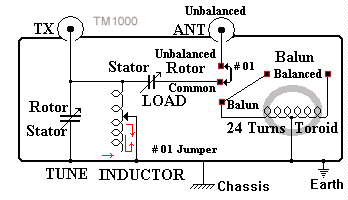 The circuit may be as in the above diagram the lower earthy end of the inductor may not be connected as this will avoid circulating RF currents. We badly need to get this diagram perfected. Hi Peter, Amateur Radio is a "Society of Friends" we all help each other. I am doing a paint spray job at the moment on a model aircraft, I decided to use VW Lahasa Metallic which is a dark charcoal. I rebuilt my 25 Amp Power supply and was pleased with the result of using that paint. Anyway.... back to the subject.... There is the potential for circulating currents as shown on the top sketch. Without the lower inductor connection the unit will still function. Regarding the high resistance on the clean bearings .... Nyogel or Servisol if they are still available should help, .. however both should be used sparingly. Try comparing the circuitry in your machine with the diagrams below I could have drawn it incorrectly, ... If so I will modify the diagram on the web page. Incidentally that page is very much out of date as the shack was abandoned after the lightening strike. Kindest regards Adrian. Stevie B wrote: Hi Adrian, I got a Nevada TM1000 Atu with the balun removed and would like to find out where you got the 360 degree calibrated plates for it. Also looking for circuit diagram and advice on to service it as it squeaks like a mouse when tuning the coil. Do I just clean the wheel slide and use a light oil or Vaseline ? Many thanks for your help. Steve Hi Steve, The calibrated plates came from a Military machine of some description. I say that with tongue in cheek as I am not sure. Many years ago there was an electronics scrap merchant who specialised in purchasing / flogging old military equipment .... The infamous “TV McDonald” who let me root through his stock and I found the plates in their original grease proof paper, purchased them from him for 20P, the pair. My vernier also squeaks and it is the slow motion drive I believe is the cause. The drive unit is susceptible to this ..... Years ago Maplin sold similar vernier slow motion drive units and they all squeak eventually. Don’t oil the vernier as it uses a friction clutch arrangement. What I have noticed is that the squeak diminished if used frequently. Clock oil is the only oil to use on the other parts as it does not evaporate and become sticky. Good Luck Adrian Google the following:- vernier slow motion and http://oneguyfrombarlick.co.uk/viewtopic.php?f=105&t=13459 Hi Adrian Thanks for your e-mail and answers to my queries I just wondered what tuning procedure if any, was recommended in the original instructions.I have copies of two articles “Getting the Most Out of Your T-Network Antenna Tuner” QST January 1995 and “A General Purpose Antenna Tuning Unit” RadCom January 1987 both very interesting. More than willing to send you copies of these copies if you are interested. With regard to the circuit diagram you traced I am sure I have read some where not to earth the bottom end of the coil because as the earthed slider moves up the windings it effectively creates a shorted turn which degrades the Q of the coil. When I built the ATU some years ago now I didn’t earth the bottom of the coil and it seemed to work OK, but I never did any comparative performance measurements. Incidentally, I overcame the high resistance of the bearing in exactly the way you suggested. I think one of the bearings is OK resistance wise on the Nevada ATU so I will use that on the “business” end of the coil. I have looked on ebay for turns counters, they are very expensive (around £50) and they won’t fit, I’m talking about the ones with the rectangular escutchion face. Looking at the plastic gear teeth on the Nevada turns counter a bit of judicious use of a needle file might just do the trick. Anyway, thanks again, I will try not to bother you any further on this subject Regards Peter 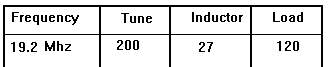 When using a tuner such as the TM1000 there is an infinite number of settings and there is no point in relying on memory, notes must be made. Eventually you will have so many notes that you will need to use a computer spreadsheet. Excel is as good as any but there are many other spreadsheets out there and available for free. The spreadsheet enables you to sort out the settings into order of frequency which speeds up searching through lists. When using a tuner such as the TM1000 there is an infinite number of settings and there is no point in relying on memory, notes must be made. Eventually you will have so many notes that you will need to use a computer spreadsheet. Excel is as good as any but there are many other spreadsheets out there and available for free. The spreadsheet enables you to sort out the settings into order of frequency which speeds up searching through lists.
On 29/04/2018 18:40, Antony Nailer G4 CFY wrote: |
 |
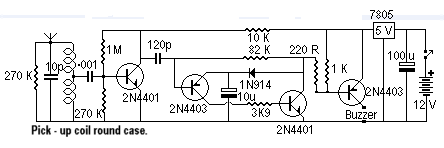
Two simple Lightening Detector Circuits.
 My home was struck by lightning on 8th June 2003 and cost my insurance company several thousand
pounds
to replace my computers and radio equipment. Lightning is a terrible force of nature and a warning of its approach
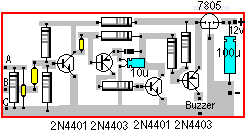
will give you time to disconnect everything, hopefully in time before a strike hits. I have also recently taken up hill walking which represents another chance of possibly being struck so I decided to do something about it. The circuit I am now using is my version of http://www.techlib.com/electronics/lightning.html which I have updated to more readily available transistors 2N3906 and 2N3904. All I need from this unit is for a buzzer to sound each time there is a discharge and to turn itself off immediately to await the next discharge. The original SCR version would not reliably turn off when using a DC supply but this more complicated version is be very economical powered by two AA cells, or with the addition of a 78L05 a miniature 12v lighter battery.
My home was struck by lightning on 8th June 2003 and cost my insurance company several thousand
pounds
to replace my computers and radio equipment. Lightning is a terrible force of nature and a warning of its approach
will give you time to disconnect everything, hopefully in time before a strike hits. I have also recently taken up hill walking which represents another chance of possibly being struck so I decided to do something about it. The circuit I am now using is my version of http://www.techlib.com/electronics/lightning.html which I have updated to more readily available transistors 2N3906 and 2N3904. All I need from this unit is for a buzzer to sound each time there is a discharge and to turn itself off immediately to await the next discharge. The original SCR version would not reliably turn off when using a DC supply but this more complicated version is be very economical powered by two AA cells, or with the addition of a 78L05 a miniature 12v lighter battery.
| SixGolds INTER-SUBJECT NAVIGATION MENU 2008 | |||
|---|---|---|---|
| IRISH VC RECIPIENTS | WINE MAKING | KITES and RADIO | ABOUT GI0SMU |
| ABOUT SIXGOLDS | RAOB SHARJAH | FARMERS MARKET | BEN NEVIS TRIP |
| WALKS PAGE | WALKERS FOOD | ULSTER GIRLS CHOIR | Reserved |
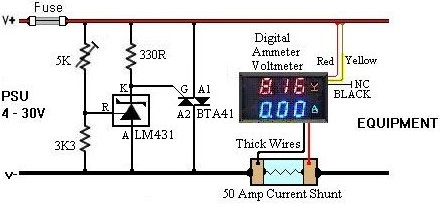 This is part of the of the voltage distribution system in my radio shack.
I have a very old power supply which may give up the ghost at any time and I don't fully trust the modern switched mode power supply unit. Rather than take any chances I decided to build a little monitoring unit to see what was happening before it reaches the distribution board where power goes to my radios.
This is part of the of the voltage distribution system in my radio shack.
I have a very old power supply which may give up the ghost at any time and I don't fully trust the modern switched mode power supply unit. Rather than take any chances I decided to build a little monitoring unit to see what was happening before it reaches the distribution board where power goes to my radios.
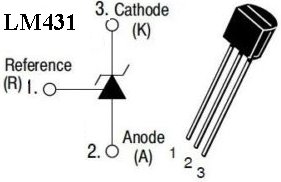
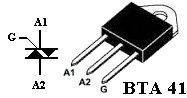 The FUSE in the circuit is a sacrificial device designed to blow whenever the Triac turns on cutting the power to the digital amp / voltmeter and everything else beyond. A single fuse from a packet of quick blow fuses rated for the radio equipment attached to the circuit is all that is needed. Once the voltage set by the 5k potentiometer is exceeded the LM431 Adjustable Precision Zener Shunt Regulator turns on triggering the Triac BTA41-600B). This causes an avalanche of current which blows the fuse cutting off the power to the equipment. Once you have fixed the problem insert another fuse and carry on until it happens again.
The BTA41-600B is capable of conducting 40 amps more than enough to blow the fuse without getting hot as the action is virtually instantaneous, it can of course be fitted with a heatsink which also gives the triac a more stable mounting
The FUSE in the circuit is a sacrificial device designed to blow whenever the Triac turns on cutting the power to the digital amp / voltmeter and everything else beyond. A single fuse from a packet of quick blow fuses rated for the radio equipment attached to the circuit is all that is needed. Once the voltage set by the 5k potentiometer is exceeded the LM431 Adjustable Precision Zener Shunt Regulator turns on triggering the Triac BTA41-600B). This causes an avalanche of current which blows the fuse cutting off the power to the equipment. Once you have fixed the problem insert another fuse and carry on until it happens again.
The BTA41-600B is capable of conducting 40 amps more than enough to blow the fuse without getting hot as the action is virtually instantaneous, it can of course be fitted with a heatsink which also gives the triac a more stable mounting 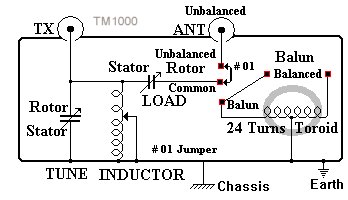
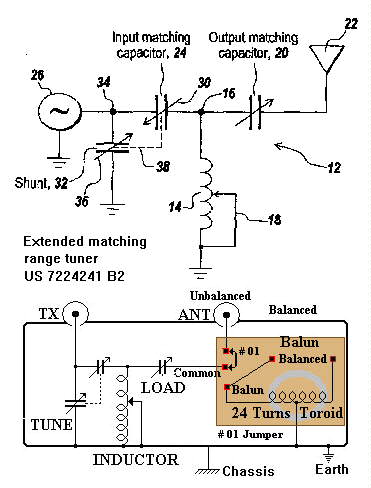 I had a search on the internet and I found this US Patent which looks exactly like the TM1000 circuit schematic.
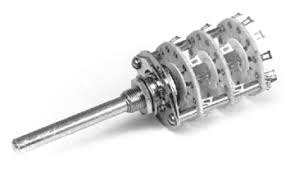 Hi Tony,
Many thanks for the good information regarding tapping the coil
at various increments using a ceramic Yaxley switch.
If I can get hold of one of these switches I haven't seen one of these
excellent switches since I retired from X-Ray Engineering.
Hi Tony,
Many thanks for the good information regarding tapping the coil
at various increments using a ceramic Yaxley switch.
If I can get hold of one of these switches I haven't seen one of these
excellent switches since I retired from X-Ray Engineering.
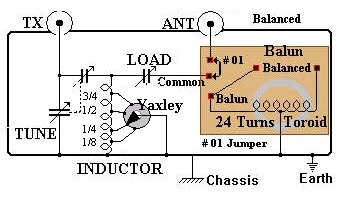 All I need is one wafer the rest are redundant but can remain resident
within the TM1000 as spares. The ideal way to connect the tappings
to the switch would be to use the silver ink pipes from a redundant
Mingograph EEG recorder. ..... but I'll make do with copper wire.
Yours is a good solution as it removes the problem of squeaking verners
and dry rotary connections.
All I need is one wafer the rest are redundant but can remain resident
within the TM1000 as spares. The ideal way to connect the tappings
to the switch would be to use the silver ink pipes from a redundant
Mingograph EEG recorder. ..... but I'll make do with copper wire.
Yours is a good solution as it removes the problem of squeaking verners
and dry rotary connections.